

Why “Prison Pulse”?
So I definitely need a new way to describe this pulse pattern, but here’s a little background on why I call it the Prison Pulse.
In the last year of my doctoral program I participated in an off-campus clinical rotation. One day, 300 patients (there were 10 of us), oh…and no metal, no blue and no skirts on women. The location? San Quentin. A maximum security prison in the SF Bay Area.
The event is an amazing collaboration. Organized at the time completely by the inmates themselves and facilitated through volunteer healthcare providers. It’s a kind of health fair as an encouragement for good behavior. Chiropractors, dentists, nutritionists etc. all donated their day to help alleviate some of the common ailments of confined living in the prison system.
The numbers game
There were two days of preparation and training on the prison protocols for visiting professionals and inmate contact. Acupuncture would not be allowed as the sharp metal needles were deemed a security risk. We would administer ear seeds instead and treat as many people as we could. Even the metal probes we usually use for point location were not allowed. So we all packed in a plastic guide tube or two to use instead. As student volunteers we took the pulse and looked at the tongue of each inmate we treated to offer them a more customized treatment protocol and frankly, to improve our diagnostic skills. When you’re learning TCM diagnostics its a numbers game. The more opportunity you have to take in the objective signs of tongue and pulse the better you become at recognizing what you see and feel.
On the inside
I actually didn’t own a pair of trousers without a zipper at the time. So, I made myself a new pair. Grey linen with a horn button fly. To this day my children refer to them as my “prison pants”. To this day I cannot describe to you what it felt like to hear the doors of that prison closing behind me.
I saw 30 people that day and we turned away at least 100 more because we just didn’t have the time. Every single one of them was one of the most grateful patients I have ever treated. The stories we heard about inmates avoiding washing their ears for months to protect the seeds they could only get once a year. The number of alcohol swabs used per patient to ensure the ear was free from dirt and oils. It had to be clean enough that the seeds would stay put. But, one thing, aside from the deep gratitude I felt for the opportunity to help these folks that I took with me this day was a pattern of pulse that I had difficulty interpreting. I dubbed it “prison pulse”.
The so-called “Prison Pulse” was what I would describe as an excess pulse that feels as though it’s wrapped in cotton wool. You can feel the excess force and full shape. It’s there on all three levels, but it almost feels deficient because there is this barrier between you and the pulse. Almost like it’s trapped.
The metaphor in the pulse
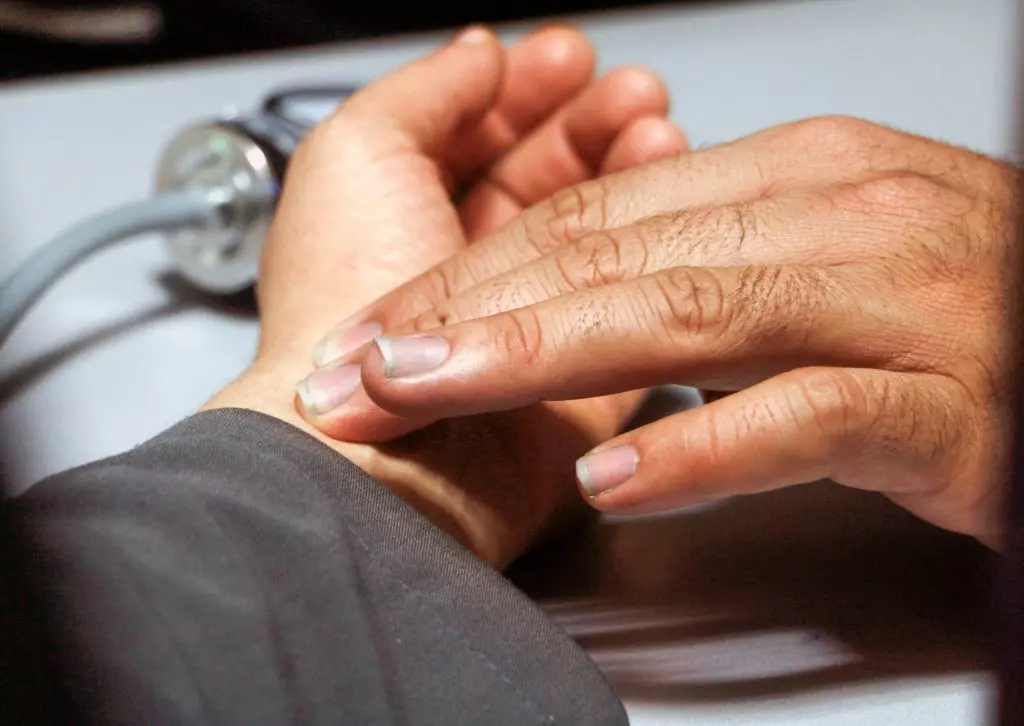
TCM pulse diagnosis has a few different schools. I think everyone is familiar with the trope of the old Chinese guy in the aromatic herb shop taking one look at a patient and knowing uncanny details about their health history. There are practitioners who are good enough at this craft that they can extrapolate similar information from a pulse. What they teach us in school is a basic set of a little less than 30 pulse patterns which are descriptions of force, shape and depth.
They are poetic. Like the “slippery pulse” being described as “like pearls moving on a plate”. If you want more information on this, I do go into more detail in my post about pulse diagnostics. Suffice to say that what I was feeling wasn’t adequately described by what I had learned. I was young, new to the craft and heck, what did I know? But what I am good at is recognizing patterns and this one was distinct. At the time, I assumed it was the stress of living in such an aggressive environment, a sort of fear+anger+poor health management. The literal interpretation of trapped being apropos in those circumstances.
The so-called “Prison Pulse” was essentially what I would describe as an excess pulse that feels as though it’s wrapped in cotton wool. You can feel the excess force and full shape. It’s there on all three levels, but it almost feels deficient because there is this barrier between you and the pulse. Almost like it’s trapped. The metaphor is too on the nose. Obviously men (predominantly men of color), who have been convicted of crimes (most likely violent crimes), mostly coming from challenged socioeconomic backgrounds. [this would be a prime opportunity to explore health and care through the lens of social justice and I would love to do that, but definitely that’s another post]. It is understandable that there would be similarities in their patterns of disharmony and their objective diagnostic criteria. Ninety percent of the patients I treated that day had this same quality of pulse. I hadn’t felt it before and I didn’t feel it again until…
On the outside
I moved to Argyll and felt this pulse again for the first time since that day at San Quentin. I was shocked and as I frequently do, felt compelled to explain what I was feeling to the patient. Side note: while there are those in my practice for whom my oversharing of my diagnostic process is one of the highlights, this is perhaps an opportunity for self-reflection on with whom and when I share these tidbits. This person reacted relatively well considering I basically compared their pulse signature to that of a hardened criminal but it made me curious.
What is it about this pulse that connects these patterns of disharmony? I live in one of the most beautiful places in the world, fresh air, near the sea vast mountain landscapes. What on earth could this environment have in common with San Quentin?
My community here Scotland albeit a mix of folks from various socioeconomic backgrounds, living in a generally peaceful, rural environment with a low population density, it just didn’t make sense. But, working in Oban specifically and understanding some of the mental health crises that the larger community in the highlands (especially the young men) face, makes me wonder if those same components (fear+anger+poor health management+…poor prospects?) Might be creating similar effects within certain local populations. We know we have a housing crisis, we know we have a suicide crisis, a drug problem (nicotine and alcohol included), and a kind of isolation particularly post-Covid.
All of these things will definitely require a much broader cadre of social solutions. But what, if anything, can TCM do other than highlight how these things may affect our physical health as deeply as our mental well being?

Easing the strain

Last month in clinic, I again was with a patient exhibiting the “prison pulse” and again, I explained what I was feeling and what that said to me about their condition and they began to weep. I immediately apologized and chastised myself for not coming up with a less provocative name, but the feeling remains. In much the same way that grief will manifest as a weakness in the Lung pulse and by mentioning this to a patient they will feel seen and free to express this emotion, I too believe that alerting a patient to the “trapped” nature of their pulse can be cathartic and helpful to their emotional journey.
Compassionate environment
I posit that in opening our lines of communication and doing what acupuncture does best: relaxing and resetting the nervous system; we can begin to unbind the body. I run a free acupuncture clinic (and have for almost 4 years now) where anyone can come every week and receive free ear acupuncture (plus ear seeds). For patients in my private clinic who exhibit this pulse, I will often include points on the Yin-Wei specifically to activate their parasympathetic nervous system.
While I specialize in mental health or what I call psycho-emotional acupuncture, I practice in a rural location and therefore treat people for many different physical and emotional ailments. As TCM is a holistic practice I find it difficult to separate one from the other. I do, however try to establish expectations within my standard of care so that when a patient does experience an unexpected emotional response, they can at least feel like that is happening in a safe and compassionate environment. Many of the things that may be responsible for a “prison pulse” are out with our control as individuals, but that doesn’t mean that we can’t be a safe community for each other to explore ways of easing these tethers and burdens.